
Project Overview
The Legend of Mir World 3D is a mobile free-to-play MMORPG based on the classic Legend of Mir IP. The game was developed by Shengqu Games (formerly Shanda Games, one of the earliest online game companies in China) and published by Tencent for the Chinese market.
It brings the familiar Legend-style fantasy world and fast 3D combat into a mobile experience designed for long-term character growth and daily online play. When I joined the team, the game was already live, and my work focused on improving its systems, progression and monetization through ongoing updates.

My Role & Responsibilities
My role on Legend of Mir World 3D grew over the life of the project. I first joined as a numerical and combat designer, and was later promoted to Lead Game Designer, I led system, economy, progression, and live-ops design, and collaborated with publishing and operations teams on product-performance goals.
Key responsibilities:
Balanced combat, skills, enemies and character growth after launch to improve game feel and difficulty curves.
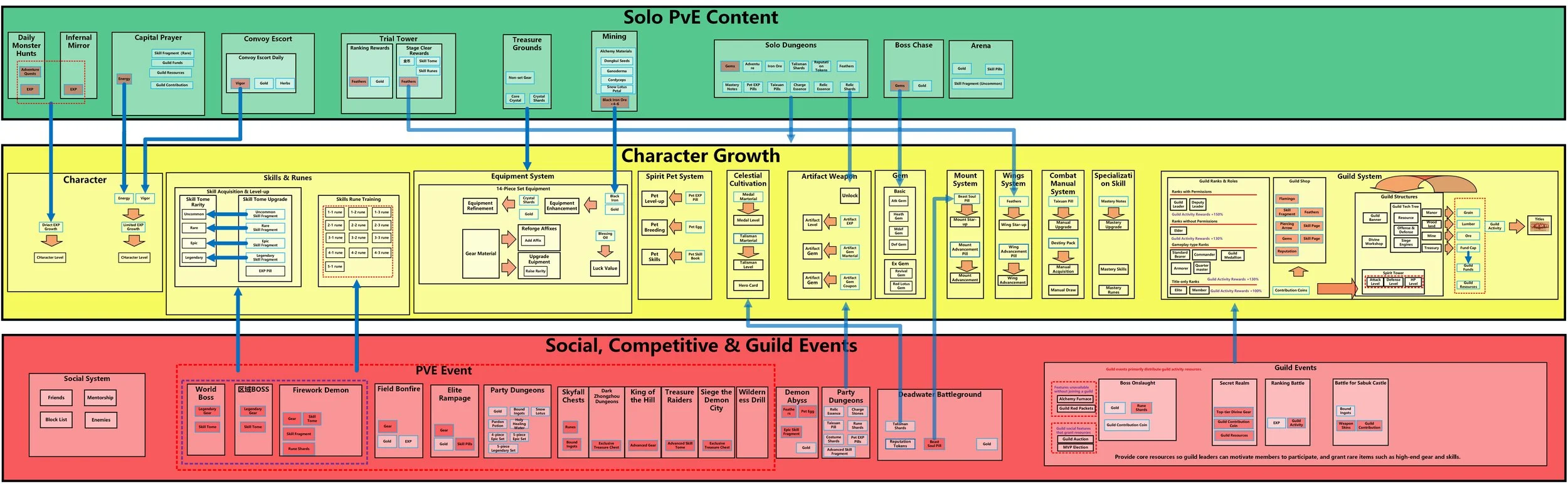
Built and maintained a high-level system framework map that connected solo content, character growth, social features and guild activities, and used it as a shared reference for team discussions.
Designed long-term progression systems such as the Artifact Weapon system and Collection Equipment Dungeons, which extended the game’s lifecycle and gave mid-core and high-spending players new long-term goals.
Owned the in-game economy and monetization design, including live-ops events based on a mental accounting model that reduced reliance on simple discounts.
Worked cross-functionally with engineering, art, operations and publishing, using weekly data reviews to plan updates and track the impact of system and event changes.

Contents
System & Content Framework
Key System Case Studies
Case Study 1 – Artifact Weapon System
Case Study 2 – Collection Equipment Dungeons
Monetization & Live-ops – Mental Accounting Events
Results & Learnings
Contents
System & Content Framework
Key System Case Studies
Case Study 1 – Artifact Weapon System
Case Study 2 – Collection Equipment Dungeons
Live-ops Event Design – Mental Accounting Model
Results & Learnings
System & Content Framework
To help the team reason about a complex live MMORPG, I created a full system and resource-flow map for Legend of Mir World 3D. The diagram groups all major features into three layers:
Solo PvE content
Character growth systems
Social, competitive and guild activities
and shows how currencies, items and rewards circulate between them.
We used this framework as a shared language for designers, producers and operations. It helped us:
See where new systems should sit in the overall loop.
Identify bottlenecks in progression and resource flow.
Discuss monetization changes without losing sight of the full player journey.
Example – High-level system and resource flow map I created for Legend of Mir World 3D.
Case Study 1 – Artifact Weapon System
Context
When I was promoted to Lead Game Designer, Legend of Mir World 3D was already a large, mature live game. The team had been shipping new systems and events for a long time, and both morale and player excitement were fading:
Designers and programmers were tired of constantly building one-off features.
Some programmers had lost confidence in previous system designs and became resistant to new requests.
Players felt that many new features were “more of the same” progression and grind.
Our live-ops team was running out of fresh, meaningful content to build events around.
At the same time, development resources were shrinking, but we still needed a way to support long-term revenue and give players new goals. I needed to design a system that could:
Use limited development resources efficiently,
Rebuild trust inside the team, and
Provide a large “content capacity” for multiple future updates.
Design
I designed the Artifact Weapon system as a long-term progression pillar that extends players’ existing skills instead of introducing a completely separate layer of complexity.
Each Artifact Weapon is built around skills that players already know. The artifact adds new effects and enhancements to those skills, so the core concept is easy to understand but deep to optimize.
Every artifact has several sockets for gems. It’s not a traditional gem-upgrade system:
Socketing gems activates artifact levels and skill effects.
Higher-quality gems unlock more powerful or more varied effects.
Different gem affixes create distinct playstyles and builds.
Gems are obtained primarily through a draw (gacha) system:
Free players can earn draw materials from existing PvE content, daily activities and guild systems.
Paying players can accelerate progress and gain extra draw attempts.
Caps and probability rules are used to control the power gap between non-paying and paying players, so progression feels fair but still rewarding for spenders.
From a production point of view, the system was designed as a reusable platform:
We could introduce 1–2 new artifacts per major version, and each artifact provided a full quarter of new build experimentation, gameplay depth and monetization capacity.
Most new content came from configuring effects and rewards, not from heavy new engineering work, which reduced resistance from the development team.
In total we planned nine Artifact Weapons, giving us a clear multi-year roadmap for high-level players without constantly inventing completely new systems.
Impact
The Artifact Weapon system helped stabilize and then improve the health of the live game under tight constraints:
For players, each new artifact created fresh combinations and goals, extending their interest in the existing combat and progression systems instead of replacing them.
For the team, artifacts became a reliable anchor for version planning: updating 1–2 artifacts per quarter was enough to support both gameplay and monetization needs, which reduced pressure on event design and engineering.
For the business, the system extended the game’s revenue curve by roughly two years while keeping active users stable, and contributed directly to performance bonuses for the team in that period.
Most importantly, the success of the Artifact Weapon system helped rebuild confidence between design and development: it showed that with the right framework, we could still deliver impactful features even with limited resources.
Case Study 2 – Collection Dungeons
Context
By the time we completed the planned roadmap for the Artifact Weapon system, it was clear that we would need another long-term system to carry future updates. At the same time, the team was under heavy constraints:
Development resources were limited and the team had been working on the game for years.
In 2022, during the COVID lockdown in Shanghai, we worked remotely for several months, which added stress and communication friction.
A retro-style competitor loosely inspired by our IP was performing extremely well in the market with a pure gear-chase loop, generating over one hundred million RMB in monthly revenue.
My goal was to bring that sense of “endless gear hunting” into our official Legend IP in a way that fit our existing game, while also giving lapsed players a reason to come back and start a new progression path. The new system needed to:
Be production-friendly and reusable under a small, tired team.
Offer real gameplay progression for normal players.
Create exciting, visible goals for high-value players.
Design
I designed the Collection Dungeons as a composite feature built around three parts:
The Collection Dungeons themselves (a series of AFK-friendly PvE instances).
Treasure Gear – accessible collection gear focused on stats and survivability.
Prestige Gear– high-end collection gear focused on visual skill effects and impactful procs.
All gear in this system comes from the Collection Dungeons:
Treasure Gear
Drops are accessible to all players, including those who mainly play on auto-combat.
These items provide strong attribute bonuses and set bonuses that help normal players catch up and stabilize the overall power ecosystem.
Treasure Gear is also used heavily in non-paid events as a core reward, keeping free players engaged.
Prestige Gear
Prestige items are rarer and are designed around passive skill effects with strong visual impact, similar in spirit to set bonuses in Diablo III.
For example: a weapon may give your basic attacks a chance to carve a spectral sword arc that leaves a persistent damage zone, continuously damaging enemies in an area.
These skills trigger automatically in combat, but their combinations and synergies become a high-end optimization space.
Paying players can accelerate their access to Prestige Gear and its unique skills, while free players still have a path to earn some pieces over time.
From a production perspective, the feature was designed as a template-driven platform:
The dungeon structure follows a repeatable pattern; new dungeons can be added primarily through configuration and tuning.
Treasure/Prestige Gear sets share common rules for stats, drop tables and skill triggers, so designers can create new sets by configuring data instead of asking for heavy new engineering work.
This made the system relatively simple for programmers to maintain, even though it provided a large amount of content capacity for design and live-ops.
In practice, this meant that for later versions we could periodically release a new Collection Dungeon plus a batch of Treasure and Prestige Gear, and that alone would provide:
Fresh build goals for players,
New material for events and promotions,
Additional monetization opportunities.
Impact
The Collection Dungeons system became a key pillar for the late-stage life of Legend of Mir World 3D:
Shortly after launch, we saw a clear uplift in performance on platforms such as iOS, as players engaged with the new gear chase and set up new long-term goals.
For normal players, Treasure Gear improved their baseline power and made it easier to stay competitive, which supported retention and community health.
For high-spending and highly engaged players, Prestige Gear offered flashy, satisfying skill effects and deep optimization space without requiring a full redesign of the combat system.
For the team, the reusable dungeon and gear framework reduced development friction and provided a predictable way to create content for future updates, even under resource constraints.
Over time, Collection Dungeons and their Treasure/Prestige Gear lines became the last major feature family added to the game — and they are still being expanded in the most recent versions as of 2025. This system continues to support both gameplay freshness and monetization, long after its initial release.
Live-ops Event Design – Mental Accounting Model
Context
Before I took over live-ops, most of our in-game events were designed and operated by a third-party team. Their main tool was discount-driven event strategy:
Events relied heavily on short-term sales and big “% off” offers.
Players quickly learned to wait for the next discount instead of buying at normal prices.
The perceived value of many items kept falling, and our overall price level was drifting down.
When I became responsible for event design, I was studying economics and behavioral concepts such as price elasticity and mental accounting. I started by:
Analysing the demand elasticity of different item categories in the game.
Segmenting players into five spending tiers, from non-spenders to top spenders, each with different value perceptions:
Top spenders pay for server-wide power and status, even at low apparent “value for money”.
High and mid spenders care more about strong visuals, special effects and reliable progression value.
Light spenders mainly react to very deep discounts on a small number of items.
Free players contribute time and activity rather than money.
My goals were to:
Reduce our dependence on deep discounts as the default event tool.
Keep most items in a low-elasticity zone, so they could be sold at stable prices over a longer period.
Use highly elastic items and progression boosts more strategically to support balance and engagement.
Design
I redesigned our live-ops events in three main steps.
Reclassifying items by elasticity and role
Items with low demand elasticity (core progression and long-term value) were moved out of frequent deep discounts, so their price level and perceived value could remain stable.
Items with high elasticity (consumables, convenience items, short-term boosts) were used more as:
Rewards in free or low-cost events, and
Entry points for light spenders to try paid content.
2. Strengthening free players and reducing long-term stat gaps
I identified long-term progression items that had created large stat gaps over time.
I made a deliberate decision to give these out more often through festival events, anniversaries and seasonal activity campaigns, as long as players stayed active and participated.
This lifted the baseline power of free and light-spending players, kept the ecosystem healthier, and gave them a stronger reason to remain engaged.
3. Introducing a three-phase mental accounting model for paid events
For paying players (roughly tiers 2–4), I designed events around a three-phase mental account:
Phase 1 – Entry and accumulation for free
Players join the event with low or zero monetary cost: logging in, playing specific modes, or completing daily tasks.
They start building up an event-specific balance (points, tokens, progress) in a separate “account” that exists only for this event.
Phase 2 – Investment and growing perceived value
As the event continues, players can invest both time and money to grow this event balance.
The more they invest, the higher the potential final reward tier they can reach.
From a psychological perspective, their sunk cost and perceived “ownership” of this account increase, making higher tiers feel more justified.
Phase 3 – Closing the account and converting value
At the end of the event, players “close” their mental account by exchanging their balance for rewards in an event shop or milestone ladder.
Higher tiers require more total investment but offer very clear, high-impact rewards (for example, key upgrade materials for systems like Artifact Weapons or Prestige Gear).
Throughout the event, we keep absolute discounts within a controlled range; perceived value comes from building and cashing out the event account, not from ever-deeper price cuts.
4. Restructuring the live-ops calendar
Instead of many small, disconnected promotions, I combined events into larger quarterly campaigns with a clear structure.
Each campaign was built around one or more major systems (for example, Artifact Weapons or Collection Dungeons) and used the three-phase mental accounting model to guide players from free participation to high-value conversion.
This made it easier to plan a full quarter of events with consistent quality, even when development resources for new features were very limited.
Impact
The new event design model had several measurable and qualitative impacts:
Stabilised item prices and value perception
We stopped the continuous downward slide in item prices and kept discounts within a more sustainable band.
Core progression items maintained their value over a longer period, which made balancing and future content planning easier.
Improved engagement across all spending tiers
Free and light-spending players gained more opportunities to catch up on long-term progression through activity-based rewards, which supported retention and daily active users.
Mid and high spenders had clearer, more meaningful reasons to invest in events, especially at the final “account closing” stage where big upgrades were concentrated.
Stronger revenue with almost no new development
In one quarter where development resources were nearly exhausted and we shipped no major new features, the redesigned event model alone contributed to a measurable double-digit revenue uplift while reducing reliance on deep-discount events.
This proved that with the right economic model and event structure, we could significantly improve monetization quality even without heavy new content.
Overall, this live-ops redesign turned events from a series of short-term discounts into a structured system that:
Respects player time and progression,
Keeps the in-game economy healthier, and
Delivers more predictable, sustainable revenue for the game.
Results & Learnings
Across the system framework, Artifact Weapon system, Collection Dungeons and live-ops redesign, my main contribution on Legend of Mir World 3D was to keep the game healthy as a long-term live service under tight constraints.
Overall results
The system & content framework gave the team a shared view of how features, currencies and rewards connect, making it easier to plan multi-year roadmaps instead of isolated one-off systems.
The Artifact Weapon system created a sustainable pillar for end-game progression, extending the game’s revenue curve by roughly two years while keeping active users stable.
The Collection Dungeons plus Treasure/Prestige Gear became the last major feature family added to the game and are still being expanded in the latest versions as of 2025, providing ongoing goals and content capacity.
The live-ops event redesign reduced our dependence on deep discounts, stabilised item prices, and delivered a measurable double-digit revenue uplift in a quarter with limited new feature development.
Together, these changes helped rebuild trust between design and development, showing that we could still deliver meaningful impact with a smaller, remote team.
Key learnings as a game design leader
Think in systems, not features.
A clear framework of loops and resource flows is more valuable than any single feature. It lets you see where to plug in new content, how to reuse existing assets and where to avoid redundancy.
Design pillars that can be extended, not replaced.
Both the Artifact Weapon system and Collection Dungeons were built as configurable platforms. This allowed us to support multiple years of updates with limited engineering, instead of constantly inventing new mechanics.
Balance fairness, progression and monetization together.
Lifting free and light-spending players through Treasure Gear and event rewards, while giving high-value players deeper optimization through Artifact Weapons and Prestige Gear, kept the ecosystem healthier and made spending feel more justified.
Use behavioural economics to improve monetization quality.
Classifying items by elasticity and using a three-phase mental accounting model for events proved more sustainable than simple price cuts. We could grow revenue while protecting long-term value and player trust.
Leadership in constraints is about focus.
Working with a reduced team during lockdown forced me to prioritise “high leverage” systems: features and event structures that could be reused, extended and combined. That focus was essential to extending the game’s life without burning out the team.